Course Schedule
About This Course
What You'll Learn
Requirements
Course Highlights
Your Instructor

Dr.Nayera Fathy Hamada Elganiny
Certified Expert Trainer
Dr. Nera is a veterinarian and food safety specialist holding a Master’s degree in Food Control and a Highfield Level 4 Certificate in Food Safety. She has strong practical experience in implementing and managing food safety systems across industrial and food sectors. Her background includes workin...
Certified Certificate
Get a certified certificate upon successful completion that you can share on LinkedIn and add to your CV
Frequently Asked Questions
After registration and payment, your enrollment will be confirmed, and you will receive the training details and instructions needed to join the course.
The course is suitable for quality, food safety, and management system professionals, internal auditors, audit team members, supervisors, managers, and anyone seeking to develop practical auditing skills.
Previous auditing experience is not required. However, basic knowledge of a management system such as ISO 9001, ISO 22000, or another management system is recommended.
No. The course covers ISO 19011 guidelines, auditing principles, audit programme management, conducting audits, and auditor competence. Internal auditing is also covered as an important auditing application.
No. ISO 19011 provides guidance for auditing management systems and can be applied to quality, food safety, environmental, occupational health and safety, and other management systems.
The course combines knowledge with practical application through activities, exercises, and audit simulations, allowing trainees to practise auditing skills rather than only studying the concepts.
Yes. Participants practise evaluating evidence against audit criteria, identifying nonconformities, and writing clear, evidence-based nonconformity statements.
Yes. Trainees receive PDF training material, along with practical templates and tools that support the application of auditing skills.
Yes. The program includes activities and assessments to evaluate the trainee's understanding and ability to apply auditing principles and skills.
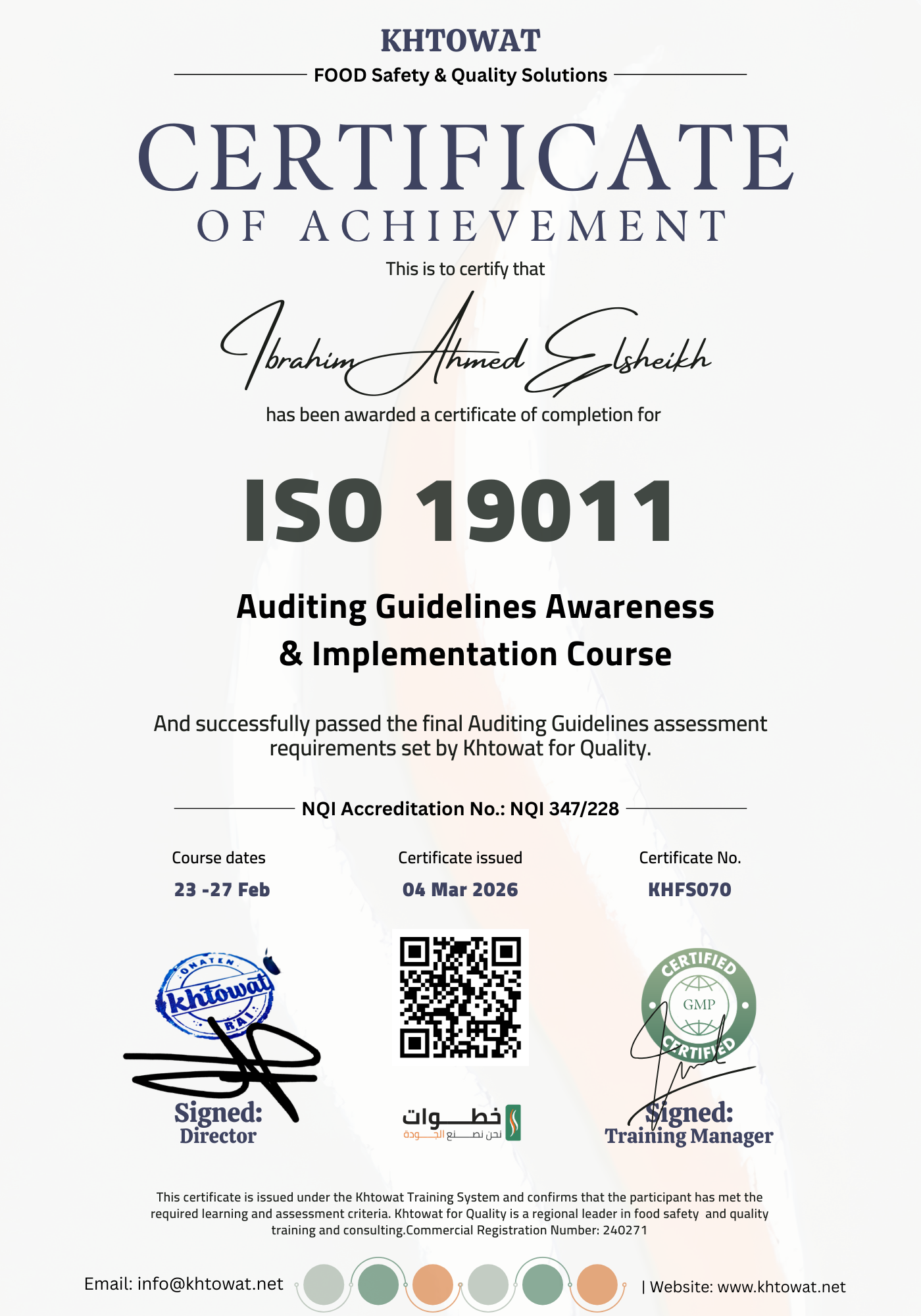
Yes. Upon meeting the program requirements, trainees receive a digitally verified certificate from Khtowat for Quality featuring a QR Code for online verification. Khtowat for Quality is licensed by the National Quality Institute (NQI) for Training, Consultation, and Qualification, with the relevant license details displayed on the certificate.
Yes. Your professional profile can display your certificates, completed courses, assessment results, training activities, and achievements and can be shared with others.
Yes. You can pay from outside Egypt. Your bank or payment provider will convert the amount and charge your card in its local currency according to the applicable exchange rate and fees.