
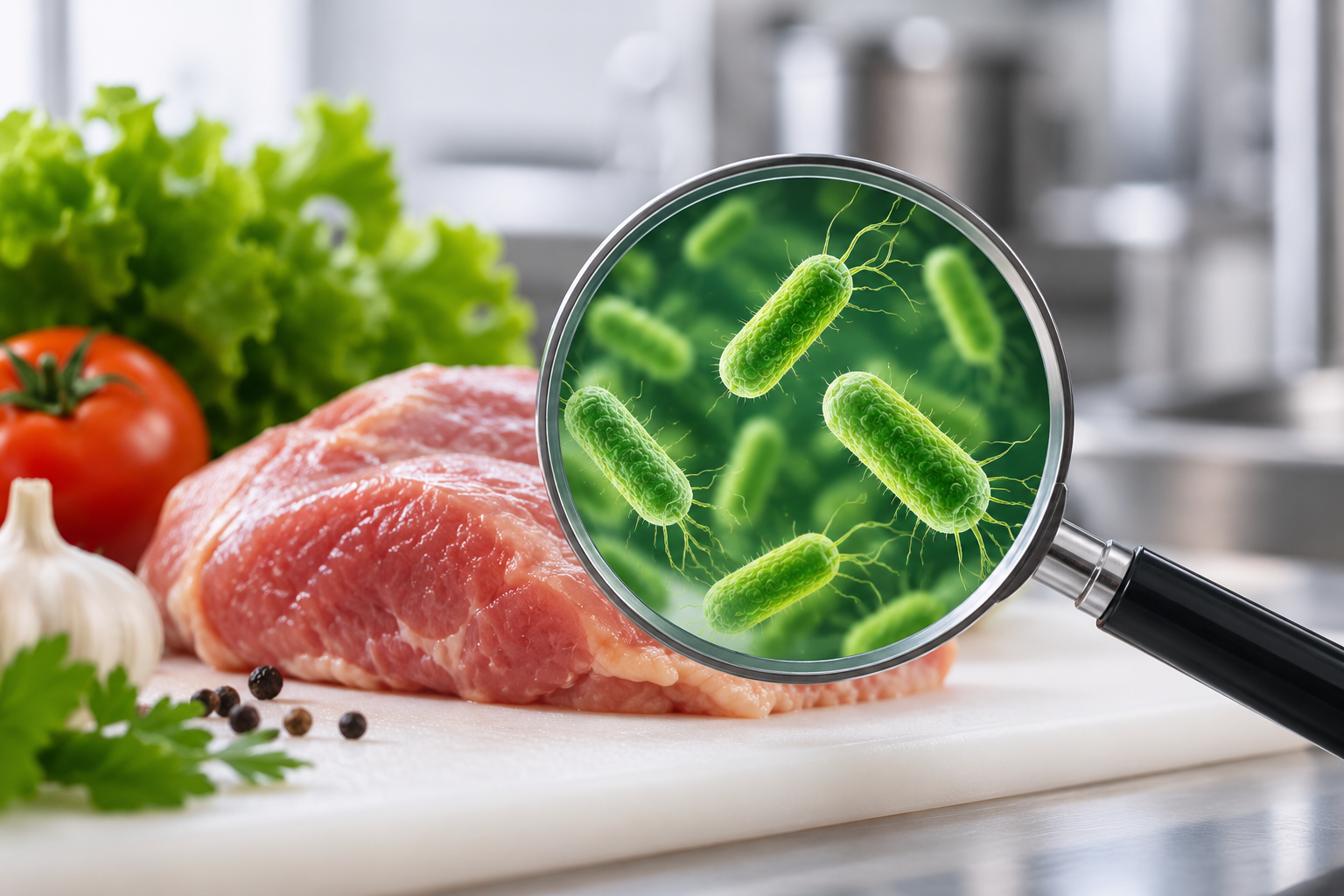

More than 1,000 cases and over 200 confirmed deaths were reported during the 2017–2018 listeriosis outbreak in South Africa, one of the largest documented listeriosis outbreaks in history. The outbreak was linked to a contaminated ready-to-eat processed meat product known as polony.
This outbreak demonstrated a critical reality for the food industry:
When Listeria monocytogenes becomes established in a Ready-to-Eat (RTE) food processing environment, the consequences can extend far beyond a microbiological non-conformance.
L. monocytogenes can grow at refrigeration temperatures, persist in food processing environments, survive in difficult-to-clean areas, and become established within biofilms. Invasive listeriosis is particularly serious, with hospitalization rates exceeding 90% and reported case-fatality rates of approximately 15–30%.
Last updated: September 2026
In 2026, the Codex Alimentarius Commission adopted a major revision of:
Guidelines on the Application of General Principles of Food Hygiene to the Control of Listeria monocytogenes in Foods – CXG 61-2007
The revised guidelines were formally adopted on 6 July 2026. The revision followed updated scientific advice and risk assessments from the Joint FAO/WHO Expert Meetings on Microbiological Risk Assessment (JEMRA), including work related to RTE diced cantaloupe, frozen vegetables and RTE cold-smoked fish. FAOHome
For food manufacturers and food safety professionals, however, the most important question is:
What does the 2026 revision mean in practice, and what should food businesses review in their current Listeria control programmes?
1. A Stronger Risk-Based Approach
One of the central messages of the revised guidance is that not all RTE foods, processes and production environments present the same level of risk.
Factors identified as important contributors to listeriosis risk include:
- Strain virulence.
- Host susceptibility.
- Amount and frequency of food consumption.
- Frequency and level of contamination.
- Presence of L. monocytogenes in the processing environment.
- Potential transfer from the processing environment to RTE food.
- Ability of the food to support growth.
- Refrigerated storage temperature.
- Duration of refrigerated storage.
- Consumer knowledge and behaviour, including unintended use.
Therefore, the question should not simply be:
“Have we detected Listeria before?”
A more appropriate question is:
“What is the actual risk associated with this product, process and processing environment?”
2. The Definition of Ready-to-Eat Food Has Become More Realistic
One of the most significant changes is the revised definition of Ready-to-Eat Food.
The revised Codex definition considers not only the manufacturer's intended use, but also whether it is reasonably foreseeable, based on evidence of consumer habits or practices, that the food will be consumed without an additional treatment sufficient to achieve food safety.
This introduces an important concept:
Reasonably Foreseeable Use
This is fundamentally different from simply considering the Intended Use declared by the manufacturer.
For example, a food may be labelled as requiring cooking before consumption.
However, if evidence demonstrates that consumers regularly consume that product without the intended listericidal treatment, that behaviour may need to be considered in the food safety assessment.
Codex provides examples involving foods such as frozen peas and enoki mushrooms, where products intended to be cooked have been consumed without the intended heat treatment.
Importantly, Codex also clarifies that reasonably foreseeable use does not mean every imaginable misuse.
There should be evidence that the behaviour can reasonably be expected within a population, supply chain or region.
This means that food safety teams should no longer ask only:
What is the intended use of the product?
They should also ask:
What is its reasonably foreseeable use?
3. Food Contact Surfaces Are Not Limited to Surfaces That Directly Touch Food
This is one of the most practically important concepts in the revised guidance.
Codex states that food business operators should consider all surfaces that could come into direct or indirect contact with food to be food contact surfaces.
That changes the way environmental contamination pathways should be assessed.
Traditionally, the question might have been:
Does the food touch this surface?
The better question is:
Can contamination from this surface be transferred to the food or to another food contact surface?
A Practical Example: Control Panels
Consider an operator working on an RTE production line.
The operator touches a control panel, then uses the same gloved hand to handle the product or touch another food contact surface.
The control panel may never directly touch the food.
Yet it can become part of a potential contamination pathway:
Control Panel → Glove → Food Contact Surface → RTE Food
Codex specifically includes examples such as the underside lip of tables and control panels touched by operators who subsequently handle food when discussing indirect food contact surfaces.
This seemingly small change has major implications for environmental monitoring and hygienic practices.
4. Personnel Can Become Vehicles for Listeria Transfer
Personnel practices are therefore an essential part of Listeria control.
Codex highlights the need to prevent personnel from transferring L. monocytogenes from contaminated surfaces to:
- RTE food.
- Food contact surfaces.
- Food packaging materials.
Personnel should wash and disinfect their hands and change gloves when they have touched an unclean surface before returning to food handling activities.
A glove should therefore never be considered inherently hygienic.
Once it touches a contaminated surface, the glove itself can become a vehicle for cross-contamination.
5. Environmental Monitoring Is More Than Swabbing
Annex I of the revised guidance provides detailed recommendations for an:
Environmental Monitoring Programme – EMP
The objective is not simply to determine whether Listeria is present.
Codex describes the purpose of the EMP as finding L. monocytogenes or Listeria spp. and harbourage sites.
The guidance describes this as a proactive:
“Seek and Destroy” approach
designed to minimize the risk of contamination and maintain food safety.
This changes the mindset from:
Sample → Test → Record
to:
Find → Investigate → Eliminate → Verify
6. Why Listeria spp. Matters in Routine Environmental Monitoring
For routine environmental monitoring, Codex recommends testing environmental samples for Listeria spp.
Their presence can indicate environmental conditions that may also support the potential presence of L. monocytogenes.
This does not mean that testing for Listeria spp. replaces direct testing for L. monocytogenes in every situation.
The EMP should define:
- When to test for Listeria spp.
- When to test directly for L. monocytogenes.
- When follow-up testing is required.
Codex also makes an important distinction regarding ATP testing.
ATP and similar assays used to assess surface cleanliness are not appropriate indicators for Listeria spp. or L. monocytogenes.
7. Sampling Locations Should Not Remain Static for Years
The EMP should include both:
Food Contact Surfaces (FCS)
and
Non-Food Contact Surfaces (NFCS).
The number and location of sampling points should reflect factors such as:
- Process complexity.
- Type of food.
- Equipment and facility conditions.
- Processing line configuration.
- Exposure of RTE food to the environment.
Sampling locations should represent every relevant processing line, line configuration and RTE processing area, including equipment used for infrequently produced RTE foods.
Codex also recommends documenting sampling points precisely.
For example:
“Inspection Table 1”
is less useful than:
“Inner surface, right side of Inspection Table 1.”
That level of precision becomes extremely important when investigating repeated positives.
8. Non-Food Contact Does Not Mean Non-Important
Examples of non-food contact surfaces may include:
- Floors.
- Walls.
- Wheels.
- Electrical conduits.
- Drains.
- Evaporator plates.
- Fans.
- Condensate drip pans.
These surfaces can provide early warning of environmental contamination before Listeria reaches a food contact surface or the product.
The objective is therefore not simply to find contamination in Zone 1.
It is to identify how contamination may move through the processing environment.
9. Zoning Should Support Decision-Making
Environmental sampling locations can be grouped according to their relationship and proximity to exposed RTE food, for example:
Zone 1 – Food Contact Surfaces
Zone 2 – Adjacent Non-Food Contact Surfaces
Zone 3 – More Remote Non-Food Contact Surfaces
Zone 4 – Areas outside the RTE processing environment
But zoning should not become merely a documentation exercise.
It should help determine:
- Sampling coverage.
- Sampling frequency.
- Interpretation of results.
- Potential contamination pathways.
- Corrective actions following positive results.
10. Sampling Frequency Should Be Risk-Based
Codex does not prescribe one universal number of environmental samples for every facility.
Sampling frequency should reflect the risk of contaminating RTE food and should consider historical data, including previous detection of Listeria spp. or L. monocytogenes.
Repeated detection of the same strain over time may indicate the presence of a potential persistent strain.
Therefore:
Sampling Frequency = Risk + Process + Environment + Historical Data
—not a fixed number copied from another facility.
11. When You Sample Matters
Sampling location is only one part of an effective EMP.
Sampling timing matters too.
Codex recommends rotating sampling between different shifts and production days to capture variations in processing conditions.
For environmental monitoring purposes, sampling during production can be particularly valuable because it allows microorganisms present in harbourage sites an opportunity to spread during operation.
Codex gives an example of sampling approximately:
3 hours into processing
Pre-operational sampling may also be used to evaluate the effectiveness of cleaning and disinfection.
The two approaches answer different questions.
12. The Number of Samples Should Also Be Risk-Based
The number of samples collected during a sampling event should reflect:
- Number of sampling locations.
- Sampling frequency.
- Time required to cover the relevant locations.
- Risk associated with the product and process.
Both food contact and non-food contact surfaces should be considered within the sampling strategy.
The objective is not to maximize the number of swabs.
It is to maximize the information generated by the monitoring programme.
13. Sample Transport and Storage Matter
Environmental sampling does not end when the swab enters the sample bag.
Codex specifies important sample handling considerations.
Environmental samples should:
- Be appropriately cooled.
- Not be frozen.
- Reach testing as quickly as possible.
- Be tested within 48 hours of collection to maximize recovery of L. monocytogenes or Listeria spp., if present.
These requirements should therefore be incorporated directly into the facility's EMP sampling SOP.
14. A Positive Result Should Not Be the End of the Investigation
Another important development is the emphasis on characterization of isolates.
Available techniques include:
- Whole Genome Sequencing – WGS
- Pulsed Field Gel Electrophoresis – PFGE
- Multilocus Sequence Typing – MLST
- Selected PCR-based methods.
These tools can help answer much more useful questions than simply:
Was the sample positive?
They can help determine:
- Whether the strain has previously been identified in the facility.
- Whether it may represent transient or potentially persistent contamination.
- Its potential source.
- Possible pathways by which it could contaminate RTE food.
This moves environmental monitoring from:
Detection
towards:
Detection → Characterization → Investigation
15. Positive Result: Do Not Stop at Clean → Resample → Negative
A common response to an environmental positive is:
Clean → Resample → Negative → Close
But this can miss the real problem.
Repeated positive findings should trigger progressively stronger investigation and corrective action until hygienic conditions are restored.
The real question is not:
“Did the next swab come back negative?”
It is:
“Why was Listeria there in the first place, and have we eliminated the source and pathway?”
This is where Root Cause Analysis becomes critical.
16. Investigative Sampling Should Search for the Source
Following a positive result, investigative sampling may need to expand beyond the original sampling point.
The investigation may consider:
- Harbourage sites.
- High-traffic areas.
- Adjacent equipment.
- Equipment interiors.
- Drains.
- Cooling systems.
- Wet areas.
- Difficult-to-clean niches.
The purpose is not simply to prove that the original location is now negative.
The purpose is to identify:
Source → Harbourage Site → Transfer Pathway
17. Special Events Should Trigger Changes to the EMP
The processing environment does not remain static.
Events such as:
- Construction.
- Installation of new equipment.
- New products.
- New ingredients.
- Roof leaks.
- Drain backups.
- Flooding.
may require additional or modified environmental monitoring.
Planned events may even require environmental monitoring activities specifically designed for that event, separate from the routine EMP.
This is particularly important because environmental contamination risks can increase dramatically during maintenance and construction activities.
18. The EMP Should Be Reviewed Periodically
Codex explicitly states that EMPs should be reviewed and updated periodically, giving:
At least annually
as an example.
The programme should also be reviewed whenever circumstances could affect the effectiveness of L. monocytogenes controls or following a loss of control, such as repeated detection of a persistent strain.
The review should examine:
- Sampling locations.
- Sampling frequencies.
- Actions following positive results.
- Trends and patterns.
- Repeated contamination locations.
Long-term analysis can reveal low-level intermittent contamination that may otherwise remain unnoticed.
19. Hygienic Design May Be the Real Cause of Persistent Listeria
Sometimes the problem is not the sanitizer.
It is not even the operator.
It is the equipment design.
Potential harbourage locations can develop in areas such as:
- Cracks.
- Crevices.
- Poor or rough welds.
- Hollow areas.
- Worn seals.
- Gaskets.
- Difficult-to-access interfaces.
- Areas where food and moisture accumulate.
Preventive maintenance is therefore part of Listeria control, because deteriorating equipment can create new harbourage sites.
20. Condensation, Water and Air Movement Matter
Wet environments can favour the persistence and spread of L. monocytogenes.
Condensation, refrigeration systems, drains, ventilation and water movement should therefore be considered within environmental control.
A facility may have an excellent sanitation chemical programme and still experience persistent Listeria if moisture continuously reaches difficult-to-clean niches.
This is why environmental control and hygienic design must work together.
21. Listeria Control Is Not Just About Chemical Concentration
Effective cleaning and disinfection require more than choosing the right sanitizer.
The process must consider:
- Chemical concentration.
- Contact time.
- Temperature.
- Mechanical action.
- Physical removal of soils.
- Disruption and removal of biofilms.
Over-reliance on chemicals without adequate physical cleaning can allow harbourage sites to persist.
22. High-Pressure Water Can Spread the Problem
High-pressure cleaning can create aerosols and spread contamination from floors, drains or contaminated equipment onto cleaner areas.
This is particularly dangerous in environments where exposed RTE food or cleaned food contact surfaces are present.
The cleaning method itself must therefore be evaluated as a potential cross-contamination pathway.
23. Temperature Control Remains Critical
One of the dangerous characteristics of L. monocytogenes is its ability to grow under refrigeration.
For refrigerated RTE foods that support growth, Codex indicates that, where feasible and appropriate, food temperatures should be maintained at no more than:
5°C
and preferably:
2–4°C
because growth is substantially reduced at lower refrigeration temperatures. control of listeria.pdfPDF
But temperature control cannot be considered in isolation.
Shelf life matters too.
24. Shelf Life Must Consider Listeria Growth
For RTE foods capable of supporting the growth of L. monocytogenes, shelf-life determination should consider whether the organism could grow to unacceptable levels under reasonably foreseeable storage and distribution conditions.
Evidence may include:
- Shelf-life studies.
- Scientific literature.
- Predictive microbiology.
- Product formulation.
- Environmental data.
- Supplier information.
This makes shelf life part of the food safety control strategy, not merely a commercial decision.
25. Does the RTE Food Support Growth?
The revised guidance distinguishes between RTE foods that:
Support the growth of L. monocytogenes
and those that:
Do not support growth.
Important product characteristics include:
- pH.
- Water activity (aw).
- Inhibitory compounds.
- Product formulation.
- Storage conditions.
However, these factors should not be considered independently of shelf life, storage conditions and reasonably foreseeable use.
The critical question is not merely:
“Was Listeria absent when the product left the factory?”
but also:
“What could happen if a low level of contamination occurs and the organism is given time and suitable conditions to grow?”
26. GHPs + PRPs + HACCP + EMP Must Work as One System
The revised guidance does not suggest creating a standalone Listeria programme disconnected from the food safety management system.
Effective control requires an integrated approach involving:
GHPs + PRPs + HACCP + Hygienic Design + Environmental Monitoring + Verification
Environmental monitoring is not a substitute for HACCP.
HACCP is not a substitute for hygienic design.
Testing is not a substitute for prevention.
And cleaning is not a substitute for understanding why contamination occurred.
What Should Food Manufacturers Review Now?
A useful starting point is to stop asking only:
“Do we have a Listeria swabbing programme?”
Instead, food safety teams should review whether:
- All relevant RTE products have been assessed.
- Products that support or do not support growth have been identified.
- Intended and reasonably foreseeable use have been evaluated.
- Direct and indirect food contact surfaces have been identified.
- Operator touch points have been evaluated.
- Cross-contamination pathways have been mapped.
- The sampling map still reflects the actual processing environment.
- Every relevant line and line configuration is represented.
- Sampling frequency is risk-based.
- Sampling timing includes appropriate operational conditions.
- The routine target organism is scientifically justified.
- Positive results trigger investigation rather than simple resampling.
- Persistent strains can be investigated when necessary.
- Hygienic design and harbourage sites are routinely reviewed.
- Maintenance and construction trigger additional monitoring where appropriate.
- Long-term trends are analysed.
- Temperature and shelf life are incorporated into the Listeria control strategy.
- The EMP is periodically reviewed and updated.
Practical Codex 2026 Listeria Review Checklist
| Review Item | Verified |
|---|---|
| All RTE foods assessed | ☐ |
| Growth-supporting RTE foods identified | ☐ |
| Intended use reviewed | ☐ |
| Reasonably foreseeable use reviewed | ☐ |
| pH and aw reviewed | ☐ |
| Shelf life reviewed | ☐ |
| Direct food contact surfaces assessed | ☐ |
| Indirect food contact surfaces assessed | ☐ |
| Operator touch points assessed | ☐ |
| Cross-contamination pathways mapped | ☐ |
| Sampling map updated | ☐ |
| All processing lines represented | ☐ |
| Line configurations represented | ☐ |
| Food contact surfaces included | ☐ |
| Non-food contact surfaces included | ☐ |
| Environmental zones reviewed | ☐ |
| Sampling frequency reviewed | ☐ |
| Sampling timing reviewed | ☐ |
| Routine target organism defined | ☐ |
| Direct L. monocytogenes testing criteria defined | ☐ |
| Sample transport/storage reviewed | ☐ |
| 48-hour testing requirement addressed | ☐ |
| Positive-result procedure reviewed | ☐ |
| Investigative sampling defined | ☐ |
| Follow-up sampling defined | ☐ |
| Root cause investigation defined | ☐ |
| Persistent strain investigation considered | ☐ |
| Isolate retention considered | ☐ |
| Characterization capability considered | ☐ |
| Hygienic design reviewed | ☐ |
| Condensation control reviewed | ☐ |
| Drain control reviewed | ☐ |
| Biofilm control reviewed | ☐ |
| Mechanical cleaning effectiveness reviewed | ☐ |
| Temperature control reviewed | ☐ |
| Trend analysis implemented | ☐ |
| Periodic EMP review completed | ☐ |
| EMP review after significant changes defined | ☐ |
Conclusion
The 2026 Codex revision should not be interpreted simply as:
“Take more Listeria swabs.”
Its practical significance is much broader.
It requires food safety professionals to think about the entire contamination pathway:
How is the product actually consumed?
Where can Listeria enter the process?
Where can it survive and establish a harbourage site?
Which surfaces can transfer it directly or indirectly?
How can personnel, equipment, water or the environment move it towards exposed RTE food?
And finally:
Is the monitoring programme designed to find the problem before the product does?
A useful way to summarize the approach is:
Risk → Environment → Detection → Investigation → Prevention
Effective control of Listeria monocytogenes does not begin when a laboratory reports a positive result.
It begins much earlier—when the food safety system is designed to identify, investigate and eliminate contamination pathways before they reach the consumer.
Primary Reference
Codex Alimentarius. Guidelines on the Application of General Principles of Food Hygiene to the Control of Listeria monocytogenes in Foods (CXG 61-2007), Revised 2026.




Leave a Comment