
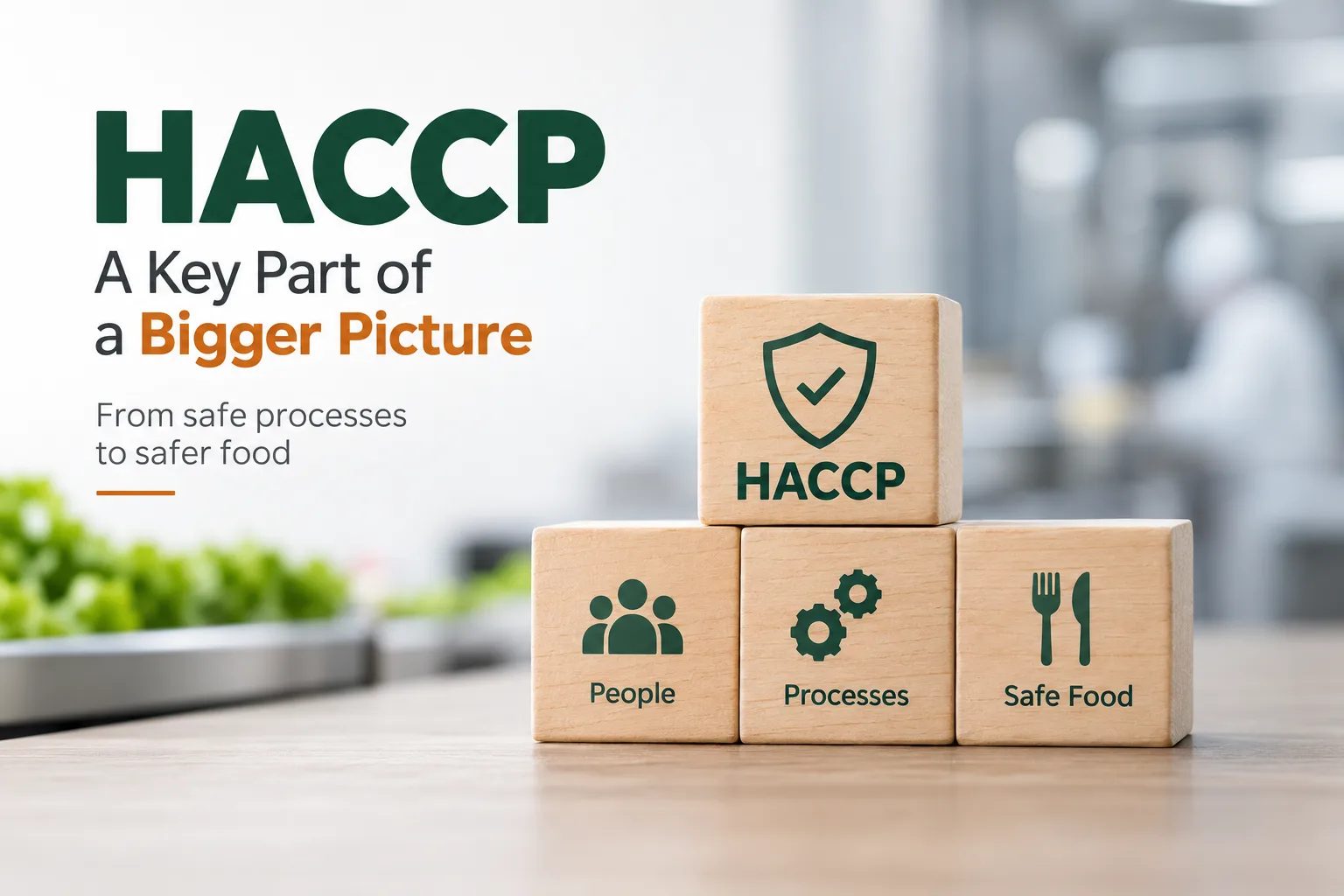
When HACCP is mentioned, three things usually come to mind immediately: hazard analysis, Critical Control Points (CCPs), and the seven HACCP principles.
But before discussing the seven principles, there is a more important question:
Where does HACCP actually sit within a food safety system?
Is HACCP itself a complete food safety system, or is it a methodology for controlling food safety hazards within a broader framework?
And if one food manufacturer implements ISO 22000, while another operates under FSSC 22000, BRCGS Food Safety, or IFS Food, are they all implementing HACCP in exactly the same way?
What about GHPs, PRPs, OPRPs, and CCPs? Where does each of them fit into the overall picture?
These questions matter because reducing HACCP to seven principles, a hazard analysis table, and a few CCPs means missing a significant part of what HACCP is intended to achieve.
At its core, HACCP provides a scientific and systematic approach to making food safety decisions throughout the production process:
What hazards could occur? Which hazards require control? What control measures are appropriate? How should they be monitored? What happens when control is lost? And how do we confirm that what we designed actually works?
But HACCP does not operate in isolation.
It requires appropriate hygiene and operating conditions to support the production of safe food. Managing food safety at organizational level also involves responsibilities, resources, communication, documentation, evaluation, and continual improvement.
This is where the bigger picture begins.
HACCP has become a central component of many food safety standards and certification schemes, but the way its principles are integrated with other elements of the system is not always identical.
So rather than simply explaining the seven HACCP principles again, this article addresses a broader question:
Does HACCP actually function as part of a system capable of preventing and controlling food safety hazards and protecting consumers?
What Is HACCP, Really?
HACCP — Hazard Analysis and Critical Control Point — is a scientific and systematic approach to identifying, evaluating, and controlling hazards that are significant for food safety.
The fundamental idea is that HACCP does not wait until the finished product has been produced before looking for problems.
Instead, it begins by understanding the process, identifying hazards that may occur, and establishing appropriate control measures to prevent, eliminate, or reduce those hazards to acceptable levels.
This is why HACCP is fundamentally a preventive approach.
Instead of asking only:
Is the finished product safe?
HACCP asks:
What could make this food unsafe? Where could it happen? And how can it be controlled before the product reaches the consumer?
However, the presence of a hazard does not automatically mean that a CCP is required.
Hazard analysis is used to identify and evaluate hazards, determine which ones require control, and select appropriate control measures.
This is also why the strength of a HACCP system should not be judged by the number of CCPs.
A facility with six CCPs does not necessarily have a stronger food safety system than one with only two.
The more meaningful questions are:
Have significant hazards been identified correctly? Have appropriate control measures been selected? And are those measures actually working?
HACCP Plan vs. HACCP in Practice
Having a well-documented HACCP Plan does not, by itself, mean that HACCP is functioning effectively.
A facility may have an excellent hazard analysis, clearly identified CCPs, completed monitoring records, and carefully documented corrective actions.
But what is actually happening on the production floor?
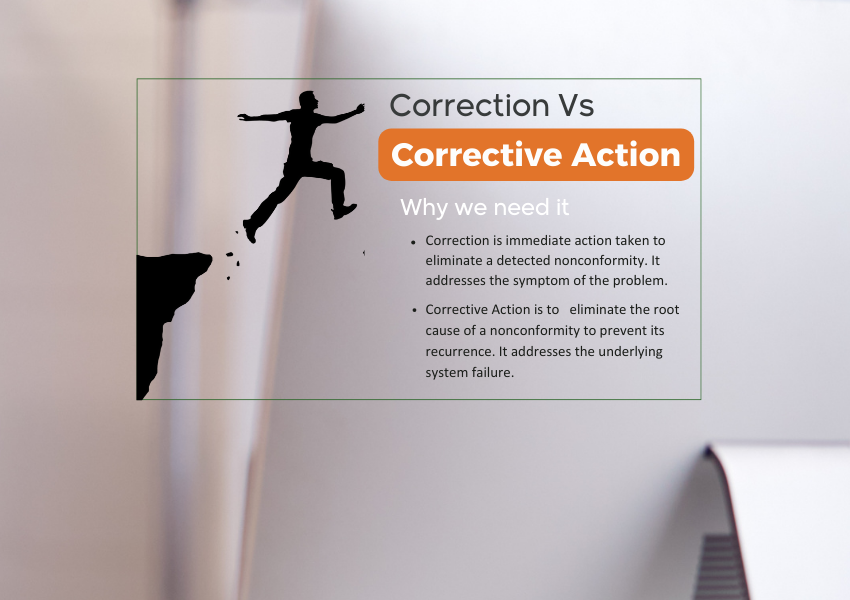
If monitoring is not performed as planned, responsible personnel do not know what to do when a deviation occurs, or the plan no longer reflects the actual process following changes to raw materials, equipment, or processing steps, good documentation cannot compensate for poor implementation.
This is the practical difference between having a HACCP Plan and having HACCP that actually works.
From End-Product Testing to Preventive Control
To understand HACCP, it is useful to understand the problem it was originally designed to address.
Traditionally, food manufacturing relied heavily on end-product inspection and testing.
But in food safety, this creates a fundamental question:
Can testing a limited number of samples prove that an entire production lot is safe?
A production batch may contain thousands of units, while only a small number are tested.
Even when all tested samples meet the required criteria, this does not necessarily prove that a hazard is absent from portions of the batch that were not sampled.
This led to a major change in thinking.
Instead of asking only:
Is the finished product safe?
The question became:
What could make the food unsafe during production, and how can we prevent or control it before it reaches the consumer?
That preventive philosophy became the foundation of HACCP.
From the Space Program to the Food Industry
The origins of HACCP are closely associated with the U.S. space program in the late 1950s and early 1960s, when Pillsbury, working with NASA and the U.S. Army Natick Laboratories, sought more preventive approaches to ensuring the safety of food intended for astronauts.
Reliance on finished-product testing alone could not provide the required level of assurance.
The focus therefore shifted toward understanding the process, identifying where failures or hazards could occur, and controlling them before they affected the finished product.
In 1971, Pillsbury publicly presented the HACCP concept at the U.S. National Conference on Food Protection.
Another important milestone came in 1985, when the U.S. National Academy of Sciences recommended broader use of HACCP for food safety. The National Advisory Committee on Microbiological Criteria for Foods (NACMCF) subsequently contributed to further developing and formalizing the approach.
Codex and the Global Development of HACCP
A major international milestone was the adoption of HACCP guidance by the Codex Alimentarius Commission, followed by subsequent revisions and development.
Today, HACCP is embedded within Codex General Principles of Food Hygiene (CXC 1-1969), one of the fundamental international references for food hygiene and food safety controls. The current Codex listing identifies the text as last modified in 2022.
But one point is essential:
HACCP was never intended to operate in isolation.
Codex places Good Hygiene Practices (GHPs) at the foundation of food hygiene systems, supporting the production of safe and suitable food.
HACCP therefore does not replace good hygiene practices. It builds on an appropriate hygienic foundation to provide a more systematic approach to controlling significant food safety hazards.
GHPs and PRPs: The Foundation Supporting HACCP
HACCP does not begin with CCPs.
Before determining Critical Control Points, an organization needs operating conditions and practices that support the production of safe food.
Within Codex, this foundation is expressed through Good Hygiene Practices (GHPs). In management-system frameworks such as ISO 22000, foundational conditions and activities are organized through Prerequisite Programmes (PRPs).
These may address areas such as cleaning and sanitation, personal hygiene, pest control, water management, maintenance, prevention of cross-contamination, waste management, and controls related to raw materials and suppliers.
The principle is straightforward:
If the basic operating environment is not under control, a HACCP Plan cannot compensate for that weakness.
For example, a heat treatment may effectively control a microbiological hazard, but inadequate separation between raw and cooked areas may allow the product to become contaminated again after processing.
This demonstrates the relationship between the foundational hygiene controls and HACCP.
GHPs and PRPs help establish the conditions necessary for safe production, while HACCP applies hazard analysis to determine which hazards require specific control and how those hazards should be controlled.
But the picture is not always as simple as:
PRPs → CCPs
Modern food safety management frameworks may organize and classify control measures differently. One of the clearest examples is ISO 22000, which distinguishes between PRPs, OPRPs, and CCPs.
This leads to one of the central ideas of this article:
The fundamental philosophy of HACCP remains consistent, but the way it is integrated and organized within a food safety system may differ depending on the framework being used.
How Does HACCP Work? From Hazard Analysis to Control
Effective HACCP implementation begins before the hazard analysis itself.
You cannot properly analyze a process you do not understand.
The process therefore starts with establishing the HACCP team, describing the product and its intended use, developing a flow diagram, and confirming that the flow diagram accurately represents the actual process.
Then comes the central question:
What could happen at each step that may affect food safety?
Relevant hazards are identified and evaluated, hazards requiring control are determined, and appropriate control measures are selected.
The seven HACCP principles then operate as an interconnected sequence:
Hazard Analysis → Determine CCPs → Establish Critical Limits → Monitoring → Corrective Actions → Verification → Documentation and Records
The important point, however, is not simply to memorize these steps. It is to understand the logic connecting them.
If a significant hazard is identified without an appropriate control measure, there is a gap.
If a CCP is identified without an appropriate critical limit, it becomes difficult to determine when control has been lost.
If a critical limit exists without monitoring capable of detecting loss of control in time, the organization may not be able to respond appropriately.
And monitoring alone is not enough; verification is needed to provide evidence that the system is being implemented and functioning as intended.
HACCP is therefore not a collection of independent tables.
It is a chain of decisions, and each decision depends on the validity of the one before it.
The way this chain is organized, however, is not identical across every food safety framework.
Where Does HACCP Sit Within Modern Food Safety Systems?
A facility may follow Codex, implement ISO 22000, or operate under certification schemes such as FSSC 22000, BRCGS Food Safety, or IFS Food.
All of these frameworks incorporate HACCP principles, but the way those principles are integrated into the broader system and the way control measures are organized are not necessarily identical.
This is where much of the terminology confusion begins.
HACCP in Codex: The Starting Point
Within the Codex General Principles of Food Hygiene, GHPs provide the foundation for controlling many food safety hazards.
Where GHPs alone are not sufficient to address significant hazards, HACCP provides the structured approach needed for more specific control.
For learning purposes, the relationship can be visualized as:
GHPs → Hazard Analysis → Significant Hazards → Control Measures → CCPs → HACCP Plan
This is a simplified conceptual representation rather than a replacement for the full Codex methodology.
What Changes in ISO 22000?
ISO 22000 does not replace HACCP.
It incorporates HACCP principles into a broader Food Safety Management System (FSMS).
Following hazard analysis and identification of significant food safety hazards, appropriate control measures are selected. Control measures managed within the Hazard Control Plan are categorized as:
Operational Prerequisite Programmes (OPRPs)
or
Critical Control Points (CCPs).
This changes the question from simply:
Is this step a CCP or not?
to:
What significant hazard are we trying to control? What control measure is appropriate? And how should that control measure be managed according to its role in controlling the hazard?
A simplified view is:
PRPs
Provide the basic conditions and activities necessary to maintain a hygienic environment.
↓
Hazard Analysis
Identifies and evaluates hazards and determines significant food safety hazards.
↓
Control Measures
Are selected to control significant hazards.
↓
OPRPs / CCPs
Provide the categories through which relevant control measures are managed.
↓
Hazard Control Plan
Organizes the control of significant hazards through OPRPs and CCPs.
This explains why terms such as OPRP, action criterion, and hazard control plan are commonly encountered in ISO 22000-based systems, while other frameworks may organize the same underlying preventive philosophy differently.
What About FSSC 22000?
An important distinction is:
FSSC 22000 is not a different type of HACCP.
FSSC 22000 incorporates ISO 22000 as one of the normative foundations of its certification scheme. Consequently, its hazard analysis and the management of relevant control measures through OPRPs and CCPs remain linked to ISO 22000 requirements.
FSSC 22000 Version 7, published in May 2026, is based on ISO 22000:2018, the applicable ISO 22002-x PRP standards, and FSSC Additional Requirements.
There is therefore no separate methodology called “FSSC HACCP.”
Instead, HACCP principles operate within the broader structure of the FSSC 22000 certification scheme.
What About BRCGS and IFS?
Certification standards such as BRCGS Food Safety and IFS Food also incorporate HACCP-based hazard-control principles, but their requirements, terminology, structure, and documentation are not necessarily identical to ISO 22000.
IFS Food is currently on Version 8, with its Version 8 Doctrine updated in April 2026.
This leads to an important lesson for food safety professionals:
Do not memorize one HACCP table from one standard and assume that it is the only correct format across every food safety framework.
The framework may affect terminology, the organization of controls, documentation, and system requirements.
But the fundamental logic remains:
Identify hazards → Evaluate them → Determine what requires control → Select appropriate control measures → Monitor control → Respond to loss of control → Verify that the system works
Are There Different Types of HACCP?
Not in the simplistic sense.
There is no separate ISO HACCP, FSSC HACCP, and BRCGS HACCP.
What we have are shared principles for the preventive analysis and control of food safety hazards, integrated and organized within different food safety frameworks.
This explains why moving from one food facility to another may reveal different terminology, forms, or approaches to classifying control measures, even though the underlying hazard-control philosophy remains recognizable.
HACCP is not the entire food safety system, but it is one of the central methodologies linking food safety hazards to the measures used to control them.
From a HACCP Plan on Paper to a System That Actually Works
A facility may have a detailed HACCP Plan, comprehensive hazard analysis, clearly identified CCPs, and monitoring records completed every day.
But none of these alone answers the most important question:
Does HACCP actually work?
The strength of HACCP is not measured by the number of pages in the plan or the number of CCPs.
It is measured by the ability of the control system to manage food safety hazards effectively during actual operations.
Monitoring, for example, does not fulfil its purpose merely because a value has been recorded.
It must be designed and implemented in a way that can detect loss of control with sufficient timeliness to support appropriate action regarding both the process and potentially affected product.
Three concepts are particularly important here:
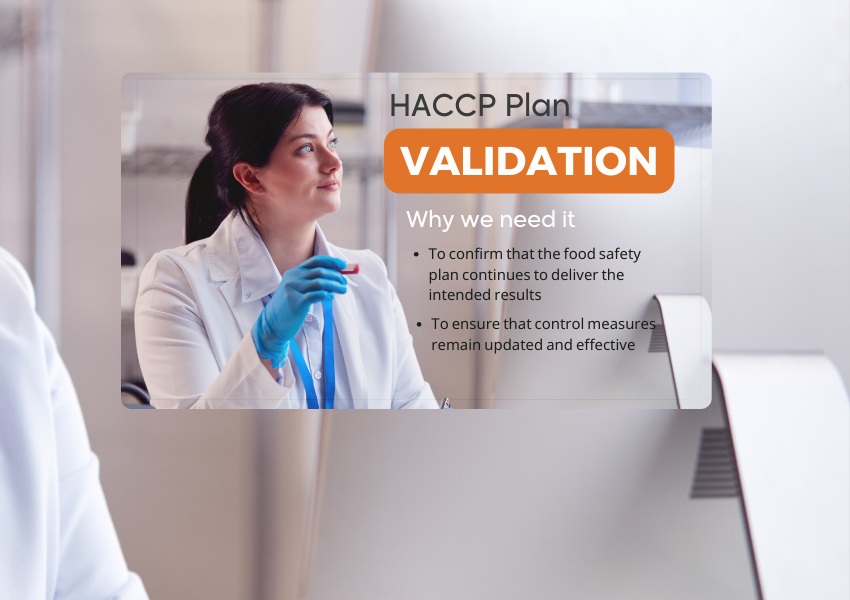
Validation asks:
Are the selected control measures capable of achieving the intended control of the hazard?
Monitoring asks:
Is the control measure operating as intended against its defined limits or criteria during operation?
Verification asks:
Is the system being implemented and functioning as planned?
These are not three different names for the same activity. They perform different functions within the food safety control system.
HACCP Must Change When the Process Changes
A HACCP Plan should not be treated as a document that is developed once and then remains unchanged.
Raw materials, suppliers, formulations, equipment, process conditions, flow diagrams, cleaning procedures, and intended product use may change.
New scientific information may emerge, and complaints, incidents, or other evidence may reveal weaknesses that were not previously recognized.
When a relevant change occurs, an essential question should be asked:
Does the hazard analysis still reflect the actual process and the actual food safety hazards?
Reviewing and updating HACCP is therefore not merely a document-control activity. It is part of maintaining effective hazard control.
People Make the Plan Work
A technically excellent HACCP Plan cannot protect the product if the people responsible for implementing it do not understand their roles.
A person responsible for monitoring needs to know more than what to record.
They need to understand what is being monitored, the applicable limits or criteria, what loss of control means, what actions are required, and how potentially affected product should be handled.
The HACCP team needs to understand the actual process, not only the requirements of a standard.
Management must also provide the responsibilities, authority, competence, time, and resources required to implement, evaluate, and improve the system.
HACCP Is Part of a Bigger Picture
We can now return to the question that opened this article:
Is HACCP a complete food safety system, or is it part of something bigger?
HACCP is a fundamental methodology for the preventive analysis and control of food safety hazards.
But it does not operate independently of its surrounding system.
It requires strong foundational hygiene conditions and programmes, sound hazard analysis, appropriate control measures, effective monitoring, action when control is lost, validation and verification, and competent people capable of implementing what has been designed.
When HACCP operates within a broader Food Safety Management System, management elements such as responsibilities, resources, communication, documentation, evaluation, and continual improvement also become part of the picture.
Whether a facility works according to Codex, ISO 22000, FSSC 22000, BRCGS Food Safety, or IFS Food, HACCP should never become merely a collection of tables prepared for an audit.
The real question is not:
“Do we have a HACCP Plan?”
It is:




Leave a Comment